STIsim is designed for modeling multiple STIs circulating on the same sexual network. This tutorial shows how to:
Run multiple bacterial STIs together
Add HIV with coinfection connectors
Compare results with and without coinfection interactions
Multiple STIs on a shared network
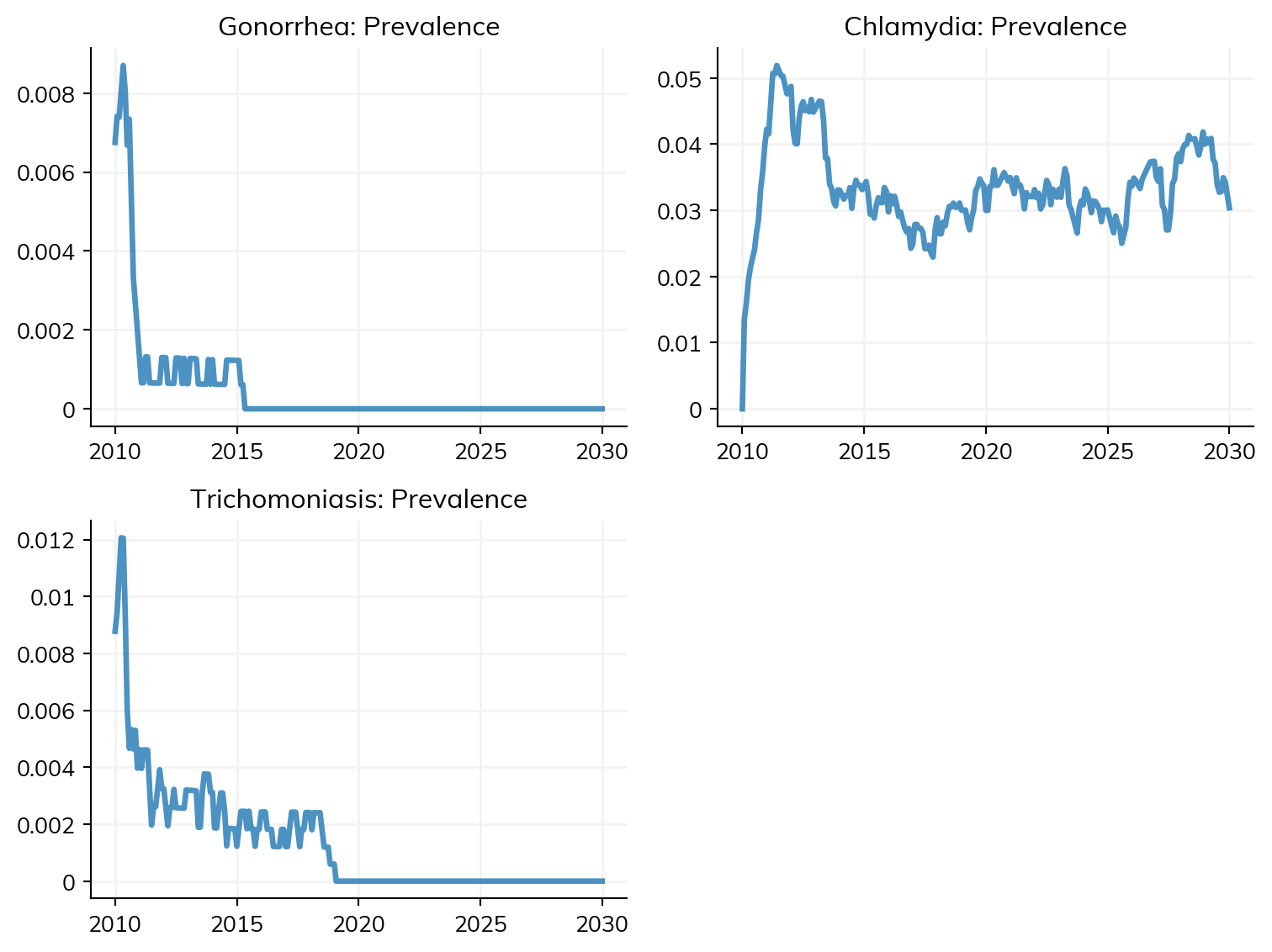
When you pass multiple diseases to a sim, they all transmit on the same StructuredSexual network. Each disease has its own transmission probability, natural history, and clearance dynamics – but the partnerships are shared.
Each disease reaches its own endemic equilibrium determined by its transmission rate, duration of infection, and clearance dynamics. Trichomoniasis typically has the highest prevalence because of its long duration of infection in women.
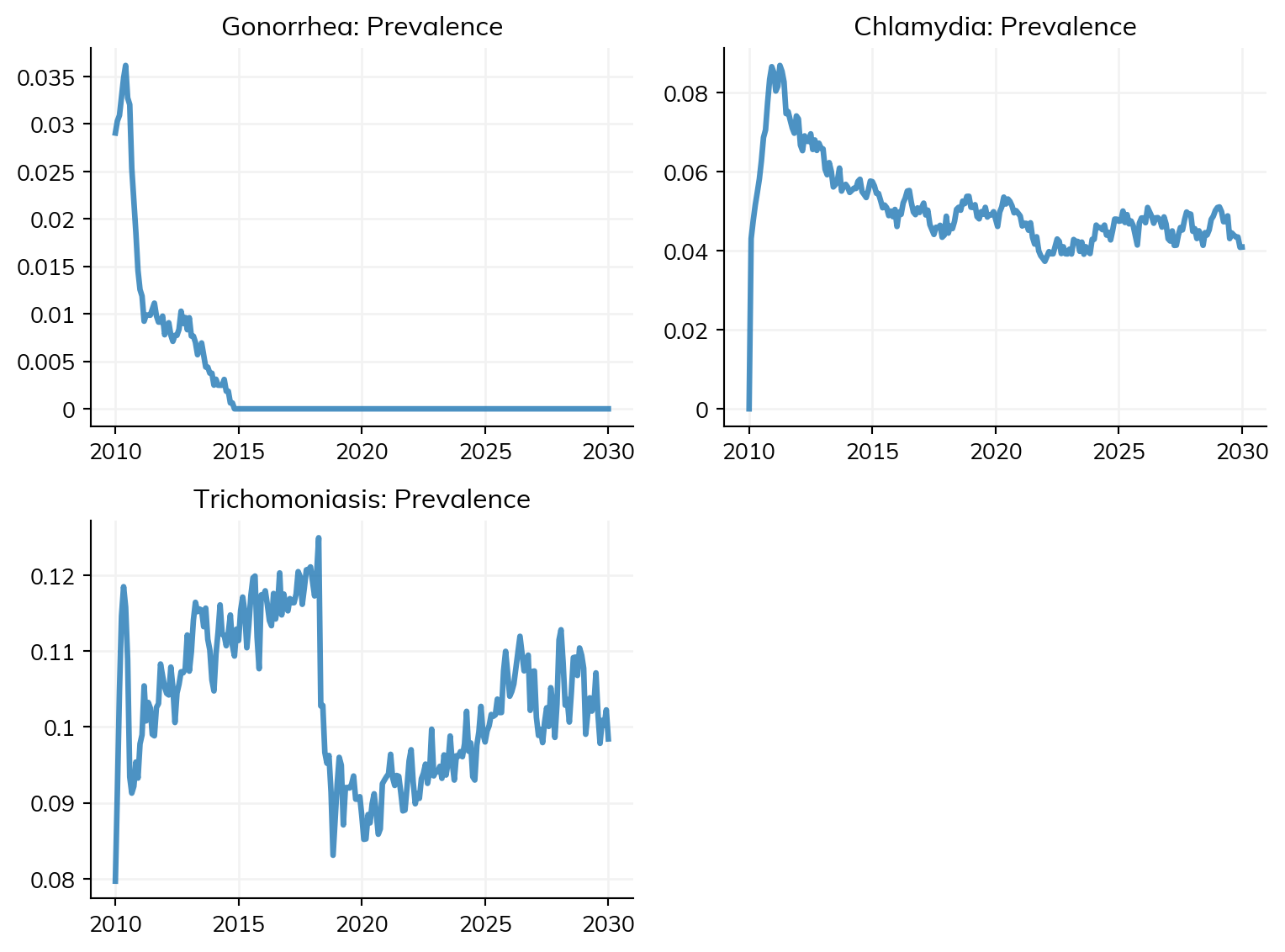
Customizing disease parameters
Use sti_pars to override defaults for each disease:
When diseases interact biologically – for example, having an STI increases susceptibility to HIV – you model this with connectors. STIsim provides connectors for HIV-STI coinfection interactions.
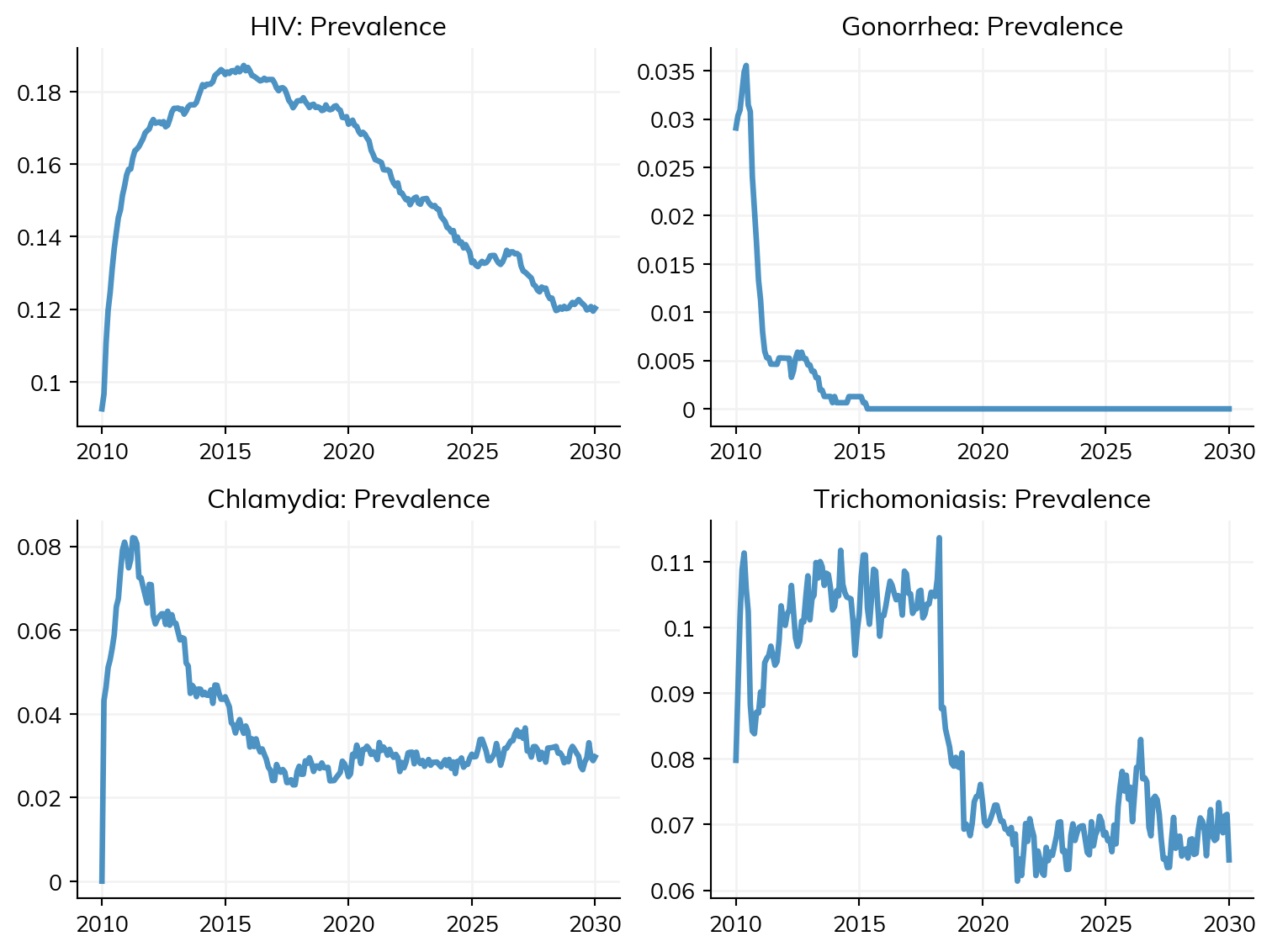
Connectors modify rel_sus (relative susceptibility) and rel_trans (relative transmissibility) for coinfected agents at each timestep. For example, hiv_ng increases HIV susceptibility for agents who have gonorrhea.
# Create disease moduleshiv = sti.HIV(init_prev=0.10)ng = sti.Gonorrhea(init_prev=0.03)ct = sti.Chlamydia(init_prev=0.05)tv = sti.Trichomoniasis(init_prev=0.08)# Create connectors for HIV-STI interactionsconnectors = [ sti.hiv_ng(hiv, ng), # NG increases HIV susceptibility (default: 1.2x) sti.hiv_ct(hiv, ct), # CT increases HIV susceptibility (default: 1.0x) sti.hiv_tv(hiv, tv), # TV increases HIV susceptibility (default: 1.5x)]sim = sti.Sim( diseases=[hiv, ng, ct, tv], connectors=connectors, n_agents=2000, start=2010, stop=2030,)sim.run(verbose=0)sim.plot(key=['hiv.prevalence', 'ng.prevalence', 'ct.prevalence', 'tv.prevalence'])
Initializing sim with 2000 agents
/opt/hostedtoolcache/Python/3.13.15/x64/lib/python3.13/site-packages/starsim/arrays.py:548: RuntimeWarning:
Trying to access non-initialized Arr object; in most cases, Arr objects need to be initialized with a Sim object, but set skip_init=True if this is intentional.
  ss.warn('Trying to access non-initialized Arr object; in most cases, Arr objects need to be initialized with a Sim object, but set skip_init=True if this is intentional.')
Figure(768x576)
Note: The HIV dynamics in this tutorial are not realistic – we have not added ART or HIV testing, which are crucial drivers of the HIV epidemic. Without treatment, HIV prevalence here is governed entirely by natural history and AIDS mortality. For realistic HIV modeling, see the hiv_kenya example, which includes testing, ART, and PrEP interventions.
Comparing with and without connectors
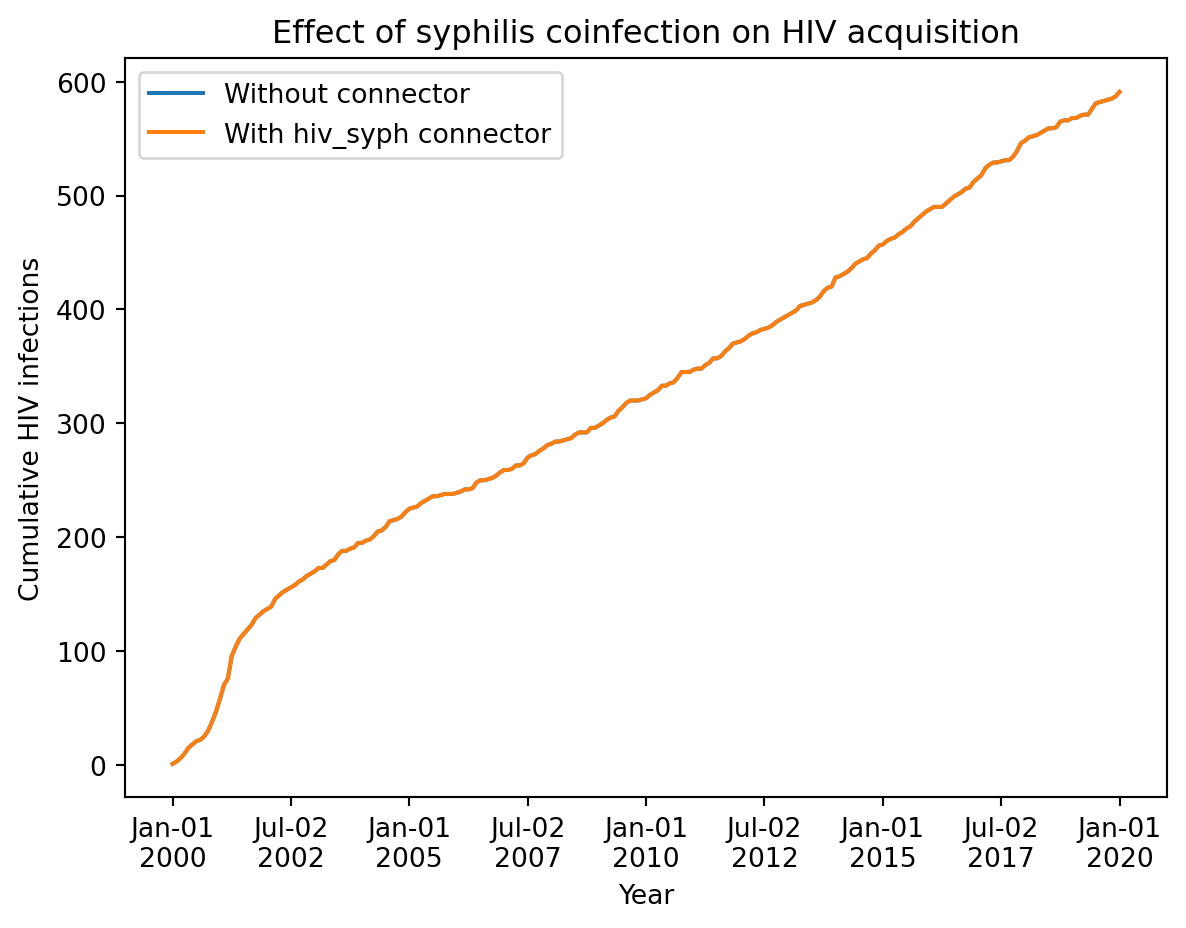
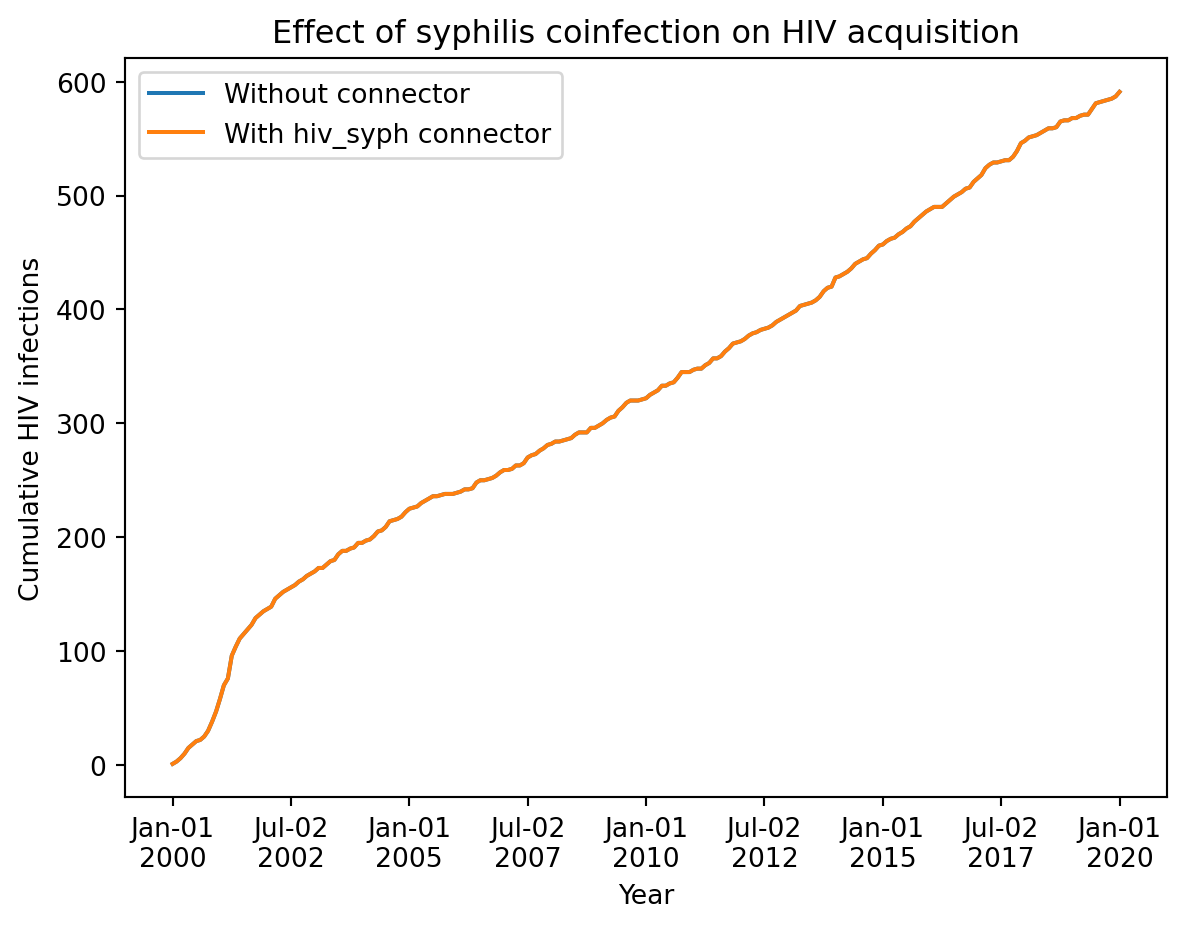
To see the effect of coinfection interactions, we compare HIV and syphilis co-transmission with and without an hiv_syph connector.
In reality, syphilis epidemics are sustained by cycles of treatment and reinfection – people with symptomatic (active) syphilis seek treatment, clearing the infection but leaving them susceptible to reinfection. Without treatment, most cases quickly progress to the latent stage, where they are far less infectious and the connector has little effect.
To make the connector’s impact visible without adding treatment interventions, we artificially extend the primary stage duration. This keeps more agents in the active (primary + secondary) stages where the connector amplifies HIV susceptibility.
import matplotlib.pyplot as pltimport starsim as ssdef make_diseases():""" Helper to create fresh disease modules """ hiv = sti.HIV(init_prev=0.02, beta_m2f=0.03) syph = sti.Syphilis( init_prev=0.10, beta_m2f=0.25, rel_trans_primary=5, eff_condom=0.5, dur_primary=ss.constant(v=ss.years(2)), # Extended for illustration )return hiv, syph# Without connectorshiv, syph = make_diseases()s0 = sti.Sim(diseases=[hiv, syph], n_agents=5000, start=2000, stop=2020)s0.run(verbose=0)# With connectors -- syphilis increases HIV susceptibility 2.67x (default)hiv, syph = make_diseases()s1 = sti.Sim( diseases=[hiv, syph], connectors=sti.hiv_syph(hiv, syph), n_agents=5000, start=2000, stop=2020,)s1.run(verbose=0)# Compare cumulative HIV infectionsfig, ax = plt.subplots()ax.plot(s0.timevec, s0.results.hiv.cum_infections, label='Without connector')ax.plot(s1.timevec, s1.results.hiv.cum_infections, label='With hiv_syph connector')ax.set_xlabel('Year')ax.set_ylabel('Cumulative HIV infections')ax.set_title('Effect of syphilis coinfection on HIV acquisition')ax.legend()fig
Initializing sim with 5000 agents
Initializing sim with 5000 agents
/opt/hostedtoolcache/Python/3.13.15/x64/lib/python3.13/site-packages/starsim/arrays.py:548: RuntimeWarning:
Trying to access non-initialized Arr object; in most cases, Arr objects need to be initialized with a Sim object, but set skip_init=True if this is intentional.
  ss.warn('Trying to access non-initialized Arr object; in most cases, Arr objects need to be initialized with a Sim object, but set skip_init=True if this is intentional.')
Available connectors
Connector
Interaction
Default effect
sti.hiv_syph
HIV-Syphilis
Syphilis increases HIV susceptibility 2.67x and transmissibility 1.2x
sti.hiv_ng
HIV-Gonorrhea
NG increases HIV susceptibility 1.2x and transmissibility 1.2x
sti.hiv_ct
HIV-Chlamydia
CT increases HIV susceptibility 1.0x (placeholder)
sti.hiv_tv
HIV-Trichomonas
TV increases HIV susceptibility 1.5x
sti.hiv_bv
HIV-BV
BV (CST4) increases HIV susceptibility and transmissibility 2x